
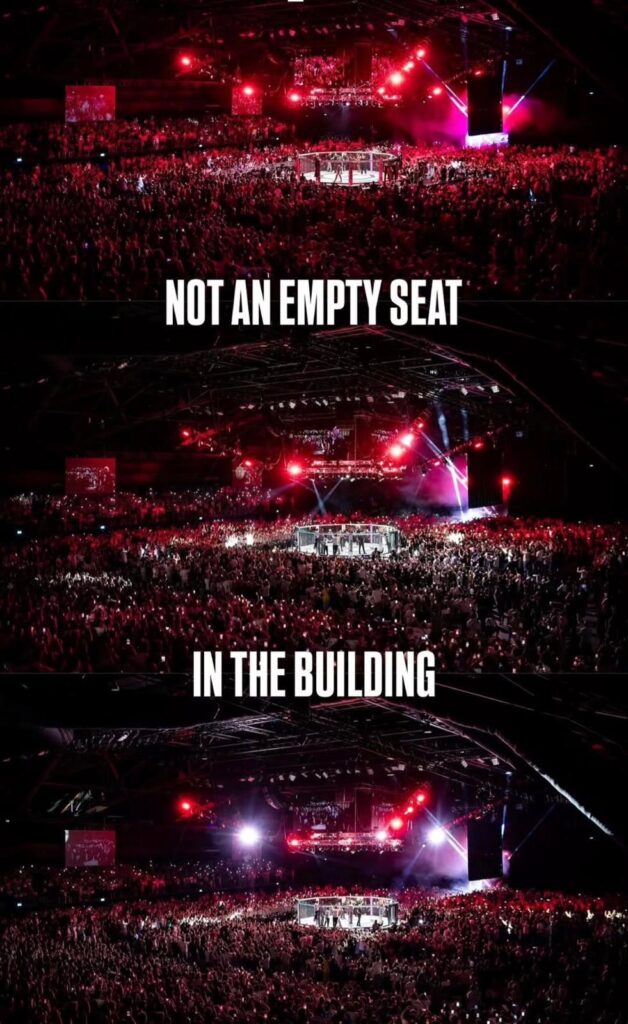
Live sports event advertising works best when it’s treated as a compounding investment rather than a one-off campaign. The events that consistently sell out are rarely first-time launches — they’re returning fixtures where each year’s media strategy builds on proven audience data, creative learnings and channel performance from the last. If you’re planning to fill an arena for a single-city, single-night sports event, the goal isn’t just reach; it’s disciplined, high-frequency coverage of a tightly defined local audience, delivered through an integrated mix that meets people at every stage between “I’ve heard of this” and “I’ve got my ticket.”
At VCM, we plan and buy media for live sports events across the calendar, and the pattern holds regardless of sport, city or promoter: build, don’t launch.
Why Returning Markets Outperform Pure Launches
A first-year event has to do the hard work of building awareness from nothing. A returning event, by contrast, already has a warm audience — people who attended last time, people who searched but didn’t convert, people who saw the out-of-home and filed it away for “next time.” Sports event media planning should treat this audience as an asset to be reactivated and grown, not rebuilt from scratch each cycle.
This is where the “build, don’t launch” principle earns its keep. Each edition of an event should:
- Retarget known ticket buyers and engaged audiences from previous editions with earlier, more targeted messaging
- Use prior-year search and social data to refine audience segments before the campaign even goes live
- Carry forward creative themes and channel mixes that proved effective, while testing incremental improvements
- Extend paid search and social budgets more efficiently as historical conversion data matures
Treated this way, sports event media planning becomes a multi-year strategy rather than a series of disconnected sprints — and filling arena seats gets measurably easier each time.
The Integrated Media Mix That Sells Out a Single-Night Event
Selling out a specific date in a specific city is a different challenge to running an always-on brand campaign. You have a hard deadline, a fixed local audience, and a need to convert intent into attendance, not just clicks. That calls for an integrated media strategy for live events that layers several channels, each doing a distinct job.
Paid Search for Event Tickets
Paid search for event tickets should be the backbone of any sports ticket sales campaign, because it captures people at the exact moment they’re already looking. This isn’t a channel for broad brand messaging — it’s for high-intent capture, and it should be segmented carefully by:
- Language, where the local audience is multilingual
- Theme (venue-specific searches, athlete or team names, general “tickets near me” queries)
- Keyword type, separating branded terms from generic or competitor terms
Bid strategy should evolve as the campaign matures: start on click-based bidding to gather signal, then move to conversion or ROAS-based bidding once there’s enough data to bid intelligently against actual ticket sales rather than traffic alone.
Paid Social With Local Creative
Paid social carries the broad-reach job — introducing the event to people who aren’t yet searching for it. For single-city events, creative needs to feel locally relevant rather than generic: local landmarks, local language, local cultural references. Appropriate language segmentation matters here too, particularly in cities with significant multilingual audiences, since a single generic ad rarely converts as well as one that speaks directly to a specific community.
Citywide Out-of-Home Blitz
Out-of-home does the heavy lifting for filling arena seats because it makes the event feel inevitable and unmissable across the city. A well-planned blitz typically combines:
- Rooftop banners for scale and visibility along key routes
- Metro and transit interiors for daily commuter repetition
- Street posters for granular, neighbourhood-level presence
- Digital out-of-home at high-footfall retail locations, timed to peak shopping hours
Radio and Organic Amplification
Radio remains a strong companion channel for live sports event advertising, particularly through partnerships with public broadcasters or culturally relevant media outlets. These partnerships often deliver organic amplification too — editorial coverage, interviews, and mentions that extend reach beyond paid media budgets and lend the event credibility.
Event-Week Street Team Activation
In the final week, street teams handle the last-mile push: distributing flyers, answering questions in person, and capturing walk-up sales from people who were aware of the event but hadn’t yet committed. This human touchpoint often converts hesitant intent into an actual ticket sale on the spot.
Why High Frequency Is a Feature, Not Wasted Spend
For a one-night, single-city event, hitting the same local audience repeatedly across search, social, out-of-home and radio isn’t inefficient — it’s the mechanism that converts awareness into attendance. Ticket buying for live events is rarely a single-touch decision; people need to see the date, the venue and the offer multiple times before they act. A tightly defined audience seen five or six times will consistently outsell a broader audience seen once. Frequency, in this context, is deliberate strategy, not a targeting failure.
FAQs
What is the most effective channel for live sports event advertising?
There isn’t a single best channel — an integrated media strategy for live events works because each channel does a different job. Paid search captures existing intent, paid social builds broad local awareness, out-of-home creates citywide inevitability, and street teams convert last-minute hesitation into sales.
How far in advance should a sports ticket sales campaign start?
Most successful campaigns begin building awareness eight to twelve weeks out, with paid search and retargeting intensifying in the final two to three weeks, and street team activation concentrated in event week itself.
Why do returning sports events sell out more easily than new ones?
Returning events benefit from historical audience data, refined creative, and established channel performance, allowing media planners to target more precisely and bid more efficiently from the outset — building on results rather than starting from zero each year.